





 April 9, 2026
 Seminar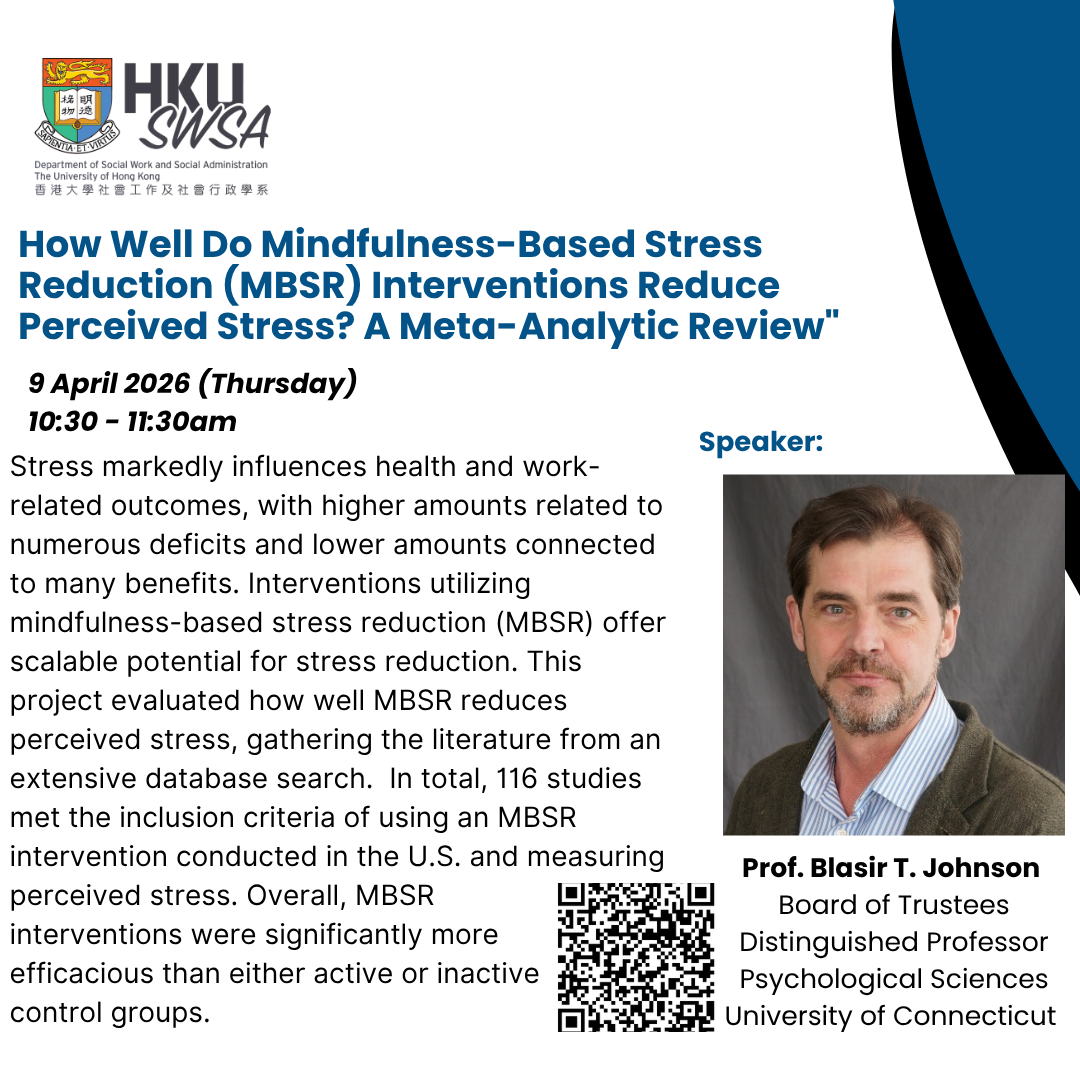
Date: 9 April 2026 (Thursday)
Time: 1030-1130 am
Venue: Chamber, 11/F, Faculty of Social Sciences, The Jockey Club Tower, Centennial Campus, The University of Hong Kong
Mode: Hybrid
Registration: https://hkuems1.hku.hk/hkuems/ec_hdetail.aspx?guest=Y&ueid=106136
on or before 8 April 2026, 17:00 (zoom link will be provided on 8 April 2026 17:30 by email)
Abstract
Stress markedly influences health and work-related outcomes, with higher amounts related to numerous deficits and lower amounts connected to many benefits. Interventions utilizing mindfulness-based stress reduction (MBSR) offer scalable potential for stress reduction. This project evaluated how well MBSR reduces perceived stress, gathering the literature from an extensive database search. In total, 116 studies met the inclusion criteria of using an MBSR intervention conducted in the U.S. and measuring perceived stress. Overall, MBSR interventions were significantly more efficacious than either active or inactive control groups. Models examining both a priori and post hoc moderators partially explained heterogeneity: MBSR succeeded in lowering perceived stress to the extent that samples had higher baseline stress, were in good health, and were composed of female participants; MBSR interventions also succeeded better when they offered participants a retreat. MBSR still significantly reduced stress for samples with lower stress, that were in poor health, for male participants, and when no retreat was part of the intervention. MBSR success was robust across levels of coded MBSR content dimensions (e.g., total time), format (e.g., in-person vs. virtual attendance), design types (randomized controlled trial vs. not), and several other features. Finally, an examination of mean post-intervention perceived stress levels, modeled on a 0 to 100 continuum, revealed that although MBSR interventions lower stress, they still leave statistically significant stress levels. This systematic review and meta-analysis is the first to examine the effects of MBSR on perceived stress in the U.S. and results are encouraging about its efficacy to decrease stress.
About the Speaker
Blair T. Johnson is a Distinguished Professor of Psychological Sciences at the University of Connecticut, where he teaches courses related to health psychology, attitude change, systematic review methods, and psychology of the arts. Johnson has been a prominent scientific methodologist throughout his career, especially concerning meta-analysis, which he dubbed “the original big data.” Other recent methods work has focused on spatiotemporal strategies to bring community- and neighborhood-level factors to bear on health behavior and health behavior change. His current research focuses on the impact of mindfulness interventions on outcomes important to mental and physical health. Related foci include social influence and behavioral health, especially HIV/AIDS, exercise and blood pressure, placebo responding in antidepressants, and other strategies to improve mental and physical health. He and his teams have been awarded numerous grants, most prominently from the U.S. Public Health Service. Prof. Johnson recently completed a decade-long term as a senior editor with Social Science & Medicine and is the outgoing Editor in Chief of Psychological Bulletin.